Registered microfinance institution· RBZ-MFI-2024-017

+263 242 700 145Contact
Alector Microfinance
LoansHow it worksCalculatorGuidesLocationsAbout
Sign inApply now
  1. Home
  2. Loans
  3. Zunde Agri-Input

Zunde Agri-Input

Agricultural and farming input loans in Zimbabwe

Zunde Agri-Input is Alector’s seasonal loan for Zimbabwean farmers. It funds what a season needs — seed, fertiliser, chemicals, feed and livestock — at the point in the calendar when those must be bought, months before any crop can be sold.

Amount
$300 – $8,000
Rate
from 18%
Term
up to 12 months
Apply for this loan Estimate my repayments
Registered institutionRBZ-MFI-2024-017
No hidden feesEvery charge on your schedule
Same working dayMost applications reviewed
Documents stay privateSeen only by you and our staff

Overview

About the Zunde Agri-Input

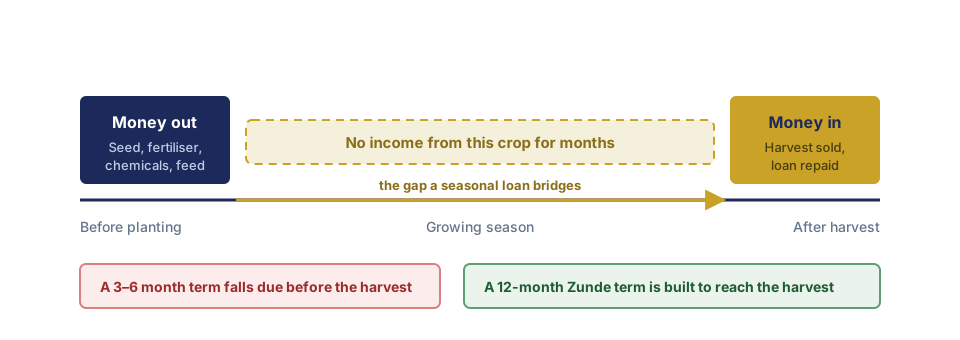
That mismatch is the central problem with financing agriculture on ordinary short-term credit, and it is why Zunde runs to twelve months: the schedule is built to sit alongside a growing season rather than cut across it.

Who this is for

  • Smallholder and communal farmers buying inputs ahead of a season
  • Livestock farmers funding feed, veterinary costs or stock
  • Horticulture and market-garden growers with a defined selling window
  • Farmers who need the longest term Alector publishes

How it works

What to expect

Timeline of a farming season showing input costs for seed, fertiliser and chemicals falling due before planting, no income for several months, and harvest income arriving afterwards. A three to six month loan term would fall due before the harvest, while a twelve-month Zunde term reaches it.
Why Zunde runs to twelve months: inputs are bought before planting, but nothing can be sold until after the harvest.
  1. 01

    Timed to the season, not the calendar month

    The twelve-month term exists so that inputs bought before planting are repaid after selling. We structure the schedule around when your income actually arrives.

  2. 02

    The largest facility we offer

    At up to $8,000, Zunde carries the highest ceiling of any Alector product, because input costs for even a modest holding run well past what a working-capital loan covers.

  3. 03

    A published rate that does not move

    Zunde starts at 18% — our highest published rate, reflecting a full season of exposure to weather and price risk. Whatever rate is on your agreement is fixed for the life of that loan.

  4. 04

    Reminders before every installment

    SMS reminders go out ahead of each due date. If a season goes badly, talk to us early — a restructured schedule is always better than an overdue one.

Before you apply

What you will need

Eligibility

  • Zimbabwean national ID or valid passport
  • A mobile number that can receive SMS
  • Aged 18 or over
  • Proof of a regular, verifiable income
  • Evidence that you farm the land — title, lease, offer letter or a letter from your local authority
  • A plan for the season showing what the inputs are for

Documents

  • Photo of your national ID (front and back)
  • Proof of residence — a utility bill or letter from your local authority
  • Proof of income appropriate to your product (payslip, bank statement or sales record)
  • Proof of land use — title deed, lease, offer letter or local-authority confirmation
  • Quotes or invoices for the inputs you intend to buy

Everything is uploaded from your phone — there is no branch queue. Read how the application process works for the full sequence, or check rates and fees before you commit.

In practice

When this loan is the right choice

Illustrative situations, not real customers. They are here because the useful question is rarely “what is the rate” — it is “is this the right instrument for what I am actually trying to do”.

Inputs for a maize crop

Seed, fertiliser and chemicals must be bought before planting. Nothing can be sold until after the harvest, seven or eight months later.

What we would suggest: This is precisely the mismatch Zunde exists for. Bring quotes for the inputs so the facility matches what you actually need to buy, and structure the schedule so the heavier repayments fall after you sell rather than during the growing season.

Feed and veterinary costs for cattle

A livestock farmer faces continuous feed and health costs but sells animals only at particular points in the year.

What we would suggest: Livestock income is lumpy rather than seasonal in the crop sense. Map your schedule to when you realistically sell, and tell your loan officer that timing at application — a schedule built around the wrong month is the commonest avoidable problem here.

Horticulture with a defined selling window

A market gardener supplies a contract that runs for four months of the year, with inputs bought two months ahead.

What we would suggest: A shorter term than twelve months may be cheaper and perfectly serviceable. Zunde runs to twelve months; it does not oblige you to use them all.

Farming land you do not own

A farmer works land under a lease, an offer letter, or an arrangement recognised by the local authority.

What we would suggest: Ownership is not required. A lease, an offer letter, or a letter from your local authority confirming you farm the land are all accepted as evidence of land use.

Avoid these

Common mistakes

Several of these cost us margin to tell you. They are here because a borrower who takes the right facility repays it, and a borrower who takes the wrong one does not.

  • Borrowing for inputs already bought on credit

    If a supplier has already advanced you inputs, you have borrowed once. Taking a loan to cover the same season without settling that first arrangement means carrying two obligations against one harvest.

  • Assuming the best-case yield

    Size the loan against a season that goes moderately, not perfectly. The instalments do not adjust for rainfall, and a schedule that only works in a good year is a schedule that fails in most years.

  • Waiting until after a poor harvest to make contact

    By then the instalment is already overdue. If the season turns in December, the conversation should happen in December — restructuring is far easier before a due date passes than after.

  • Treating the twelve-month term as a target

    It is a ceiling. A shorter term costs less in total. Use the full twelve months only if your income genuinely arrives that late.

Honest routing

When a different product suits you better

Sending someone to the wrong facility helps nobody. If any of the following describes you, start there instead.

  • You are buying and reselling goods on a short cycle rather than growing a crop over a season.Consider the Mbizi Working Capital instead
  • This is your first loan and you would rather establish a record before taking the largest facility we offer.Consider the Alector Starter instead

FAQ

Agricultural and farming input loans in Zimbabwe: common questions

What can an agricultural input loan be used for?

Seed, fertiliser, agricultural chemicals, livestock feed, veterinary costs and stock purchases. We ask for quotes or invoices for the inputs at application so the facility is sized to what you actually need to buy.

Do I need to own the land to get a farming loan in Zimbabwe?

No. Ownership is one option among several — a lease, an offer letter, or a letter from your local authority confirming you farm the land are all accepted as evidence of land use.

Why is the rate on agricultural loans higher?

Zunde carries a full season of exposure before any repayment can realistically come out of a harvest, and that period carries weather and commodity-price risk. That is reflected in the published rate, which starts at 18% and is fixed on your agreement.

What happens if my harvest fails?

Contact us as early as you can. A missed installment is flagged as overdue and pauses further borrowing, so it is far better to discuss restructuring the schedule before a due date passes than after.

Terminology

Words used on this page

If any of these are unfamiliar, that is worth fixing before you sign anything — with us or with anyone else.

Term
The length of time you have to repay a loan, usually expressed in months.
Repayment schedule
The document listing every instalment you owe, its exact amount and its due date.
Restructuring
Rewriting a repayment schedule so it fits changed circumstances — best agreed before payments are missed.
Interest basis
The rule for how a quoted rate is actually applied — the single most important question to ask a lender.
Arrears
Money that is overdue — an instalment whose due date has passed without full payment.
Read the full loan glossary

Availability

Available across Zimbabwe

Applications are handled online and reviewed by the same team wherever you are. Our office is in Harare.

  • Loans in Harare
  • Loans in Bulawayo
  • Loans in Gweru
  • Loans in Kwekwe
  • Loans in Mutare
  • Loans in Masvingo
  • Loans in Victoria Falls

Keep reading

Other loans and guides

  • SME and working capital loans in Zimbabwe

    Short-term working capital for traders, retailers and informal SMEs who need to restock or bridge a receivable.

    Read more
  • Vehicle and equipment finance in Zimbabwe

    What we can and cannot fund when a business needs an asset — stated plainly, including when to go elsewhere.

    Read more
  • First-time and micro loans in Zimbabwe

    The entry point for borrowers with no formal credit history — small, short, and designed to build a record.

    Read more

Apply for the Zunde Agri-Input

Applying is free and takes a couple of minutes. You will see your limit and full repayment schedule before you accept anything.

Apply now +263 242 700 145WhatsApp

Free to apply · No hidden fees · Most applications reviewed the same working day

Alector Microfinance

Fair, transparent credit for Zimbabwe’s traders, farmers and salaried workers.

14 Nelson Mandela Avenue
Harare, Zimbabwe
+263 242 700 145WhatsApp usinfo@alectormicrofinance.co.zw

Loans

  • All loan products
  • Salary advance loans
  • SME & working capital
  • Agricultural input loans
  • Micro & first loans
  • School fees loans
  • Vehicle & equipment

Where we lend

  • Loans in Harare
  • Loans in Bulawayo
  • Loans in Gweru
  • Loans in Kwekwe
  • Loans in Mutare
  • Loans in Masvingo
  • Loans in Victoria Falls

Learn

  • All borrowing guides
  • What documents you need
  • Building a credit history
  • How loan interest works
  • If you cannot repay
  • Spotting a loan scam
  • Loan glossary

Company

  • About Alector
  • How it works
  • Repayment calculator
  • Rates & fees
  • Frequently asked questions
  • Contact us

Legal

  • Responsible lending
  • Privacy policy
  • Terms & conditions

Borrow responsibly — only take what you can repay. Alector will never ask you to pay a fee to release a loan, and will never ask for your password or a one-time code.

© 2026 Alector Microfinance. All rights reserved.

Registered microfinance institution · RBZ-MFI-2024-017

Call Alector Microfinance on +263 242 700 145: Call usApply now

+263 242 700 145 · Free to apply · No hidden fees